The idea, in plain English
Start here.
To use AI for writing in your brand voice, supply approved examples, explain the writing choices they demonstrate and define the reader and situation. Ask for a draft using verified material. Review voice and factual meaning separately: a sentence can sound exactly like your brand and still make an unsupported promise.
Imagine a repair studio that explains things calmly and plainly. Its AI draft calls a routine assessment a ‘revolutionary transformation’ and promises a repair date nobody confirmed. The problem has two parts: the language is off-brand and the commitment is invented. Editing only the adjectives would leave the more serious error intact.
A few words you’ll meet.
OPEN WHAT YOU NEED ↙Brand voice
The recognizable writing choices a brand uses, such as vocabulary, point of view and how it explains a next step.
Tone
How that voice adapts to the reader’s situation, such as a reassuring service update or a lively event invitation.
Approved example
A piece of writing you are allowed to reuse as a style reference, with an explanation of what makes it suitable.
Voice guide
A practical reference of writing behaviors, examples and boundaries that writers and reviewers can apply.
Turn a feeling into a writing choice
‘Warm and professional’ is a starting preference, but it gives a reviewer little to inspect. Translate it into behavior. For the fictional repair studio, warm means acknowledging the inconvenience without blaming the customer. Clear means naming the item and the next action. Calm means explaining an uncertainty without an exaggerated reassurance.
Show the distinction in a short example. ‘Send a photo of the damaged seam so we can assess the work’ is more useful than ‘Experience our exceptional solutions.’ Neither is a universal sentence template. Choose examples that represent your own service and audience; permission to imitate a style does not supply permission to reuse someone else’s claims or confidential material.
Separate the voice reference from the source facts
Label the sample as a style reference and supply the factual brief separately. Explain which features to imitate: ordinary verbs, accurate service names, an understandable next step. Also say which details in the example must not be carried over. A sample appointment date or price is not evidence for the new message.
Ask for a draft that follows the relevant guide and uses the supplied facts. Adding examples to a prompt is context for that interaction; it is not the same as retraining the underlying model. Do not assume the assistant will retain the guide in another session or tool. Save the approved guide in a place your workflow can reliably retrieve and check the actual product’s behavior when persistence matters.
Tune the language. Preserve the facts.

Adapt to the situation without losing the reader
A service delay and a launch announcement need different emphasis. In a delay update, lead with the status, its practical effect and the next known step. In an invitation, explain the event and how to join. A shared preference for clear, respectful language can work in both; forcing the same joke or sales hook into each message cannot.
Keep qualifications that change meaning. ‘We can assess the seam from a photo’ does not mean ‘We can guarantee the repair from a photo.’ A confident voice should express supported facts clearly and leave uncertainty visible. Avoid style rules that require every statement to sound certain or every paragraph to open with a statistic.
Edit in separate passes and improve the guide
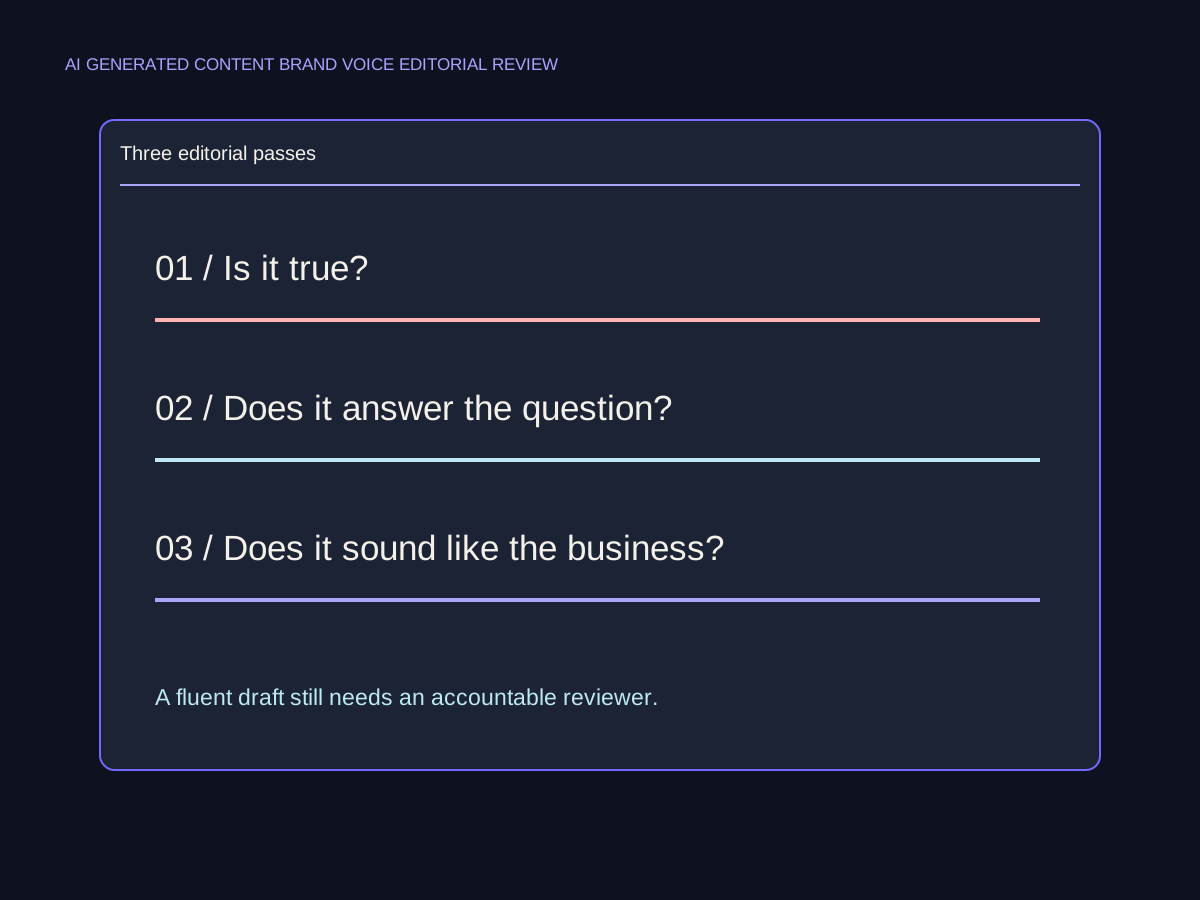
First compare the draft with its factual brief: service scope, dates, conditions, claims and omissions. Then assess the reader’s situation, vocabulary, tone and next step. Finally read the message as a whole. Separate passes make it easier to notice a factual change hidden inside an attractive rewrite.
Give specific feedback: ‘Keep the unconfirmed completion date open; replace the exaggerated opener with the current status.’ Save a corrected example and the reason when the same problem recurs. Test a new task against the updated guide before treating it as settled. Measure any time saving in your own workflow, including review and correction; there is no universal editing-time reduction or voice score that proves success.
A calm update with a real boundary
Original fictional brief: Alder Repair has received a jacket; the seam needs assessment; the customer will receive an estimate after that assessment; the completion date is unknown. Voice reference: plain language, respectful acknowledgment and a concrete next step. A suitable draft is: ‘We’ve received your jacket. We’ll assess the seam and send an estimate for the work. The completion date is still to be confirmed.’
| Draft choice | Voice decision | Meaning check |
|---|---|---|
| We’ve received your jacket. | Lead with a useful status. | Receipt is confirmed in the brief. |
| Assess the seam and send an estimate. | Use ordinary verbs and a concrete next step. | Assessment comes before the estimate. |
| Completion date is still to be confirmed. | State uncertainty calmly. | No invented Friday deadline or repair guarantee. |
Put it into practice
Write a guide an editor can use
Use the Alder Repair brief. A proposed update says: ‘Unlock flawless restoration! Your jacket will be ready Friday.’ No assessment or completion date has been confirmed.
- Write an observable rule for clear, respectful language.
- Identify the unsupported claims separately from the voice problems.
- Draft a replacement that preserves the known status and next step.
- Explain how the tone would change for an event invitation without importing event details into this update.
- Save one corrected example with its reason.
Keep your working notes in your own document. This page saves only your completion check, not your answers or customer data.
Check your understanding
Make the call.
Choose an answer for each question. Then compare the reasoning.
You have a useful next step.
- Describe writing choices and show approved examples.
- Separate source facts from the style reference.
- Check meaning and voice, then keep useful corrections.
Completion is your own learning record. Quiz scores and practice checks are saved separately, on this browser.
Sources & context
The sources below explain the factual foundations and editorial methods used in this lesson. Worked examples, planning models and exercises are illustrative teaching material.
- GPTHuman: Build a brand voice guide for AI tools
Editorial method for observable principles, contextual examples, tone and human review; not evidence of ranking or commercial results.
- OpenAI: Prompting
Previously reviewed primary guidance on useful context, examples, boundaries and revision. Prompt context is not described here as model retraining.
- OpenAI: Use ChatGPT
Previously reviewed primary guidance to verify important claims and use product capabilities in their actual context.
Explore the full companion guide
This lesson is also part of the journal. Keep reading for the original guide, supporting references and further detail.
AI-assisted content keeps a recognizable brand voice when the draft starts with verified material, a clear reader and concrete examples of approved writing. Give the tool boundaries, then review factual accuracy separately from style. A fluent or familiar-sounding draft is not automatically a reliable explanation.
Start with source material and a real reader
Describe the question the page should answer and the situation the reader is in. Include what they already know, what they need to decide and which information the business can verify. This is more useful than asking for an authoritative article about a broad keyword.
Supply the actual material: approved service facts, current process notes, product specifications or original research with its date and scope. Separate those facts from suggestions and examples. The customer-question content process helps connect the brief to authentic inputs. If important information is missing, ask the model to identify the gap rather than fill it with a plausible company detail.
Turn brand voice into usable examples
Choose a few passages the business considers accurate and recognizably its own. Explain what makes them work: plain terms, a direct opening, the amount of technical detail and the way uncertainty is stated. Contrast them with a short example of wording you would edit. An adjective such as professional can mean very different things without those examples.
Write a compact voice note with the audience, preferred terminology and claims the business cannot make. Adjust the tone to the task: a support instruction may be more direct than an introduction to a service. Keep the factual standard consistent. The aim is useful, recognizable communication, not a repeated signature phrase in every paragraph.
Give the model a bounded writing brief
Ask for a draft that answers one reader decision using the supplied sources. Specify which facts are approved, how missing information should be marked and where examples must be labeled. Include the intended format and the next useful action. A bounded task makes the output easier to review than an instruction to write a complete SEO article and invent whatever it needs.
For an explanatory page, the following prompt is a practical starting point. Replace the labels with your actual audience, question, approved facts and voice examples. Keep source notes attached to the claims so a reviewer can follow them. Do not paste confidential customer information into a general drafting workflow when an anonymized summary can supply the context.
Reader: [specific situation and decision]\nQuestion: [the one question this page should answer]\nApproved facts and sources: [material, date and limits]\nVoice examples: [passages with notes on what to preserve]\nTask: Draft a clear answer, then explain the conditions and next step.\nLimits: Do not invent company experience, quotes, prices or statistics.\nMark missing facts as [TO VERIFY]. Label hypothetical examples.\nReturn a separate list of claims that need checking.Review facts separately from wording
First check the claim, then check how it is expressed. Confirm the source, date, audience and context of each meaningful statement. Verify calculations and the conditions behind figures. A reference link only helps when the linked page supports what the draft says. Remove invented testimonials, qualifications, guarantees or results rather than trying to make them sound less confident.
Then edit the voice and explanation. Replace vague benefits with the actual process or decision. Define unfamiliar terms and vary the structure when the information calls for it. Read the opening and next-step wording together: they should describe the same task. A content marketing workflow needs both factual input and editorial responsibility; polishing sentences is only part of the work.
Add information the draft could not know
Use the business's verified material to give the page substance: a documented process, a concrete explanation of an option or an example with stated assumptions. Keep any claim about experience tied to real evidence. Originality is not achieved by changing synonyms in another publisher's article or introducing deliberate mistakes.
Orbit Media's 2026 survey reports that 92.4% of its 1,042 respondents use AI for blogging. That describes adoption within a self-reported content-marketer sample, not proof that AI improves a business's results. The practical question is what your draft adds for the reader. If it only repeats generic advice without a useful explanation, improve the inputs and contribution before increasing production volume.
Publish with clear responsibility and upkeep
Google's generative-AI guidance stresses accuracy and review and warns that generating many pages without adding user value may violate its spam policies. Check the complete package, including titles, descriptions, image alternatives and any structured data. A correct body paragraph does not make a misleading headline acceptable.
Name the actual publisher or contributor and describe production methods where that context matters. Label generated imagery when a reader could otherwise mistake it for real business evidence. Keep a record of sources and assign someone to revisit changing facts. Before publication, a responsible business reviewer should confirm the facts only they can know; the use of AI does not remove that responsibility.
Start with a verified source set and examples of the voice you want. Use AI for a bounded draft, check claims separately from wording and add material that helps the reader make a real decision. Release the page only when the facts and package are ready.
Does Google ban all AI-assisted content?
Its guidance focuses on accuracy, quality, relevance and added value. Generating many pages without value may violate spam policies. Review the actual content and the applicable guidance rather than assuming a tool makes it acceptable or unacceptable.
Can a better prompt remove the need for review?
No. A clearer brief helps produce a more reviewable draft, but facts, business commitments and the finished explanation still need checking.
Should we claim a human edited the article?
Only when that review actually happened. Identify real contributors and production methods accurately. A publisher name or automated check should not be presented as a completed human editorial review.
Companion guide references
- Google Search Central: Using generative AI content ↗
Official guidance on accuracy, added value, review and metadata.
- Orbit Media: Blogging Statistics 2026 ↗
Original survey of 1,042 content marketers; AI adoption is a sample observation rather than a causal outcome.
Put it into practice SEO Supreme
Edit an unsupported claim without losing the meaning.
Illustrative AI draft: 'Our award-winning team guarantees first-page results in thirty days.' Without approved evidence, the sentence contains several unsupported claims. A better edit begins with what the business can actually confirm.
Remove the invented proof.
Delete 'award-winning' unless the relevant award and attribution are confirmed. Do the same with fictional customer results or unnamed studies. A polished tone cannot supply the missing evidence.
- Unverified award
- Invented result
- Remove unsupported proof
Remove the guarantee.
Do not replace a ranking guarantee with another version of the same promise. Explain the actual work, such as reviewing priority pages and documenting recommended improvements, within the agreed scope.

Make the final sentence specific.
An illustrative alternative is: 'We review your priority pages and turn documented findings into a practical improvement plan.' Check that even this description matches the actual offer before publishing it under the business's name.