







A little deeper. A useful next step.
Learn paid search before the first live campaign.
Connect the customer’s search, the ad, the landing page and the outcome. Practice the planning decisions without spending an advertising budget.
Understand the campaign before funding it.
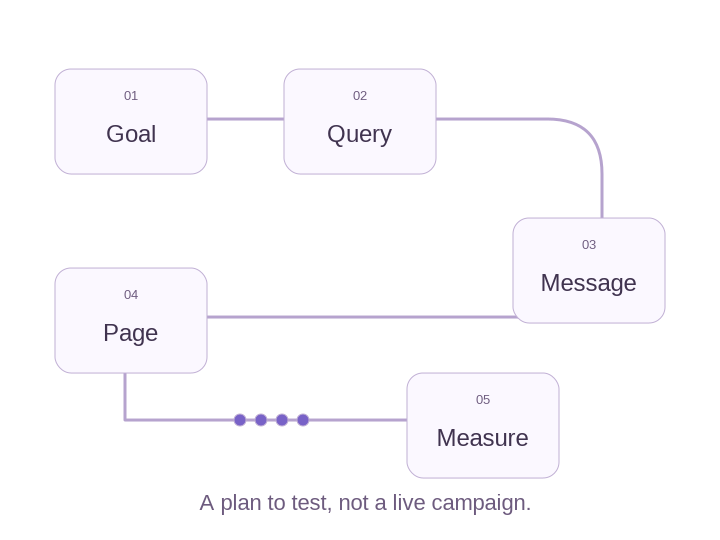
Search engine advertising, or SEA, uses paid placements to reach people in search experiences. In this path, the practical job is to explain which customer need a search campaign should serve and how the website will handle the response. A campaign brief needs an offer, an audience, a destination and a defined outcome.
The introductory exercises do not require an advertising account or launch a campaign. Use the fictional briefs and practice lab to explore campaign structure, targeting, ad wording and measurement. Real account settings, platform rules and financial commitments need their own authorized review before a live launch.
Compare keywords, match types and search terms before deciding which searches a campaign should try to reach.
Keep the promise connected to the outcome.
- SearchThe person’s actual need
- AdThe relevant offer
- PageThe information and action
- OutcomeThe defined result to check
Follow the search from query to useful action.
A fictional repair studio offers zipper repairs but does not recruit sewing staff. A search containing a sewing-related word is not automatically a useful lead. Read the task behind the search, then check whether the ad and destination offer what that person expects.
The keyword entered by an advertiser and the term searched by a person are different things. Match types govern the relationship between them; even exact match can include the same meaning or intent. The landing page should then explain the actual service and allow the visitor to complete a sensible next step.
Use the numbers as assumptions you can question.
A simple planning model can translate assumed spend and click cost into modeled clicks, then apply an assumed action rate. Each output depends on the inputs and the definition of that action. Label the assumptions, units and missing evidence rather than treating a precise-looking result as a forecast.
Measurement should also match the intended outcome. A button click, a successfully received request and a qualified enquiry are different observations. Before using a campaign report to recommend a change, inspect what was recorded, which period it covers and what the available data cannot establish.
Use budget, bids and unit economics to inspect the assumptions behind a click-based planning scenario.
Before you continue
Useful questions.
Direct answers.
Will the practice lab spend money or create an ad?
No. The School exercises are planning and calculation activities, not a connected advertising account. A live campaign requires a separate authorized setup, account review and spending decision.
Does exact match mean only an identical search phrase?
No. Google’s exact match can include searches with the same meaning or intent. Learn the distinction between targeting keywords and actual search terms, and check current platform documentation when making real account decisions.
Is a calculator result a campaign forecast?
The classroom calculation is conditional on the assumptions you enter. It helps you see how the arithmetic works and which inputs matter. It does not establish actual click prices, conversion behavior, billed costs or future performance.
Does finishing this path provide Google certification?
This is an independent learning path with its own exercises and project. Google’s official training and certification process is provided through Skillshop. Do not treat completion of this School path as an official Google credential.
Sources & further reading
- Google keyword matching optionsBroad, phrase and exact matching, including meaning and intent.
- Google Ads conversion trackingDefining and measuring valuable actions after ad interactions.
- Google SkillshopThe official Google Ads training and certification route.