The idea, in plain English
Start here.
A content brief is a small set of decisions that guides a page before drafting starts. It identifies the reader’s question, the intended page, the necessary evidence, the scope and the review standard. An outline lists sections; the brief explains what those sections need to accomplish.
A customer asks whether a laptop sleeve will fit their computer. ‘Write about laptop sleeves’ gives a writer a subject, but leaves the important work unresolved. A useful brief turns the question into a clear assignment: what the reader needs to check, which product facts must be verified and which compatibility claims must remain open.
A few words you’ll meet.
OPEN WHAT YOU NEED ↙Content brief
The context and decisions a writer needs to create a useful, reviewable page.
Outline
The proposed sections and their order. It is one possible part of a brief, rather than the whole assignment.
Scope
The question and boundaries the page will cover, including adjacent topics it will deliberately leave out.
Review standard
The checks a draft must pass before it is ready for the next authorized step.
Keep the question and its context together
Start with the reader’s situation. Record the question in ordinary language and explain what prompted it. Someone choosing a protective sleeve may need fitting instructions; someone who already ordered may need the return process. Similar product words can hide different tasks.
Label where the question came from: an anonymized customer conversation, a research observation or a brainstorm. One question is evidence that someone asked it, rather than proof of a large search audience. Then finish the sentence ‘After reading, this person should be able to…’. That sentence gives the assignment a practical purpose.
Choose the page before prescribing the article
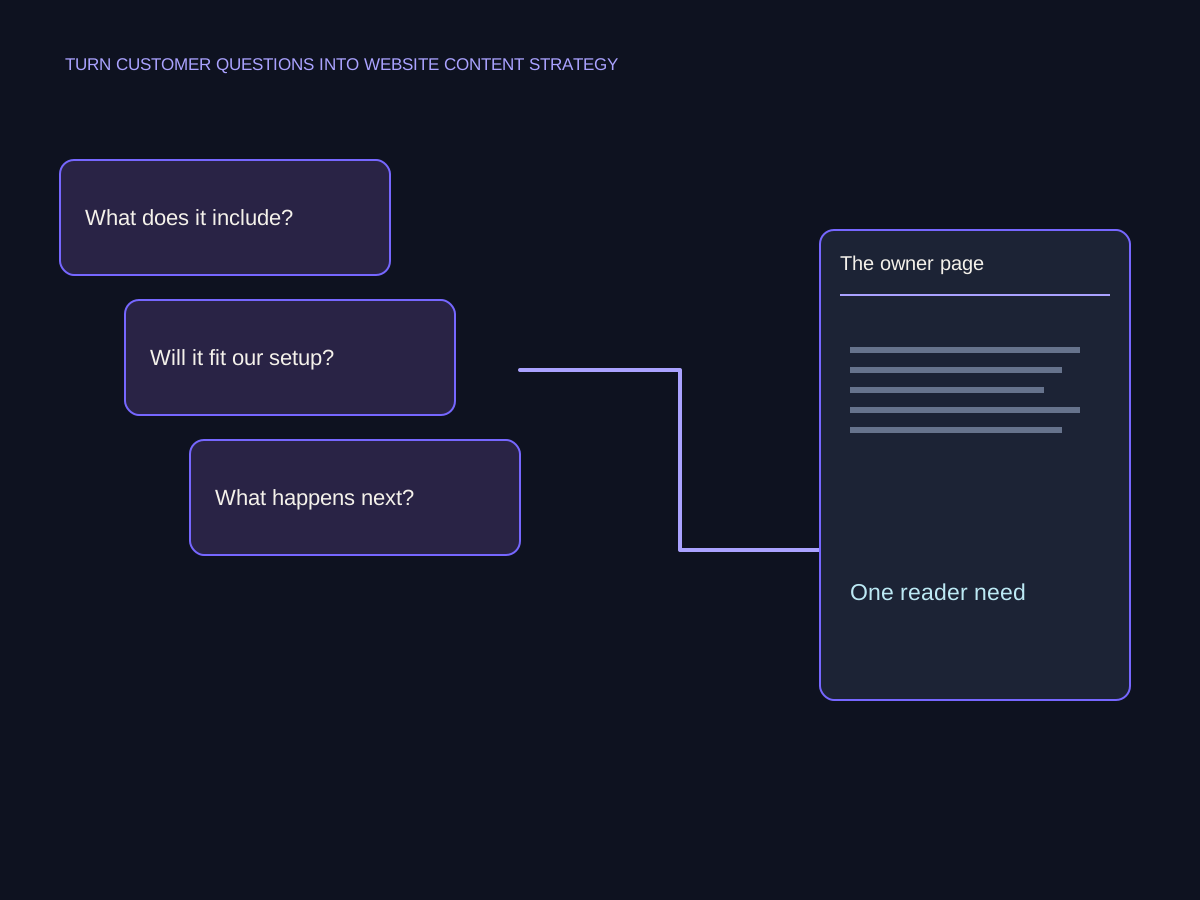
Check existing content for the right home. A product-specific fitting detail may belong beside the product. A reusable measurement process might justify a guide. A question about an existing order may belong in support information. Record the intended owner and its current status so the writer does not accidentally create another overlapping answer.
Set boundaries around that task. For a fitting guide, you might include the verified measurement method, relevant product dimensions and what to do when information is missing. Leave out an unrelated history of bag materials. The format should make the answer easier to use; a labeled diagram or compact table may do more than another long paragraph.
- Name the intended existing page or mark the proposed owner clearly.
- List the necessary information and meaningful exclusions.
- Choose a useful format without copying a competitor’s outline.
A brief connects the task to a reviewable answer

Connect each section to evidence
Give every proposed section a job. ‘Measurements’ becomes ‘Explain which measurements the maker’s fitting method requires, supported by the current product sheet’. This makes the draft easier to check and identifies gaps before the writer fills them with a guess.
Distinguish a source, an observation and an illustrative example. A manufacturer’s current sheet can support that product’s documented specifications; a fictional practice table cannot verify compatibility. If a fact is missing, identify the person or source needed to confirm it. Do not ask a writer or AI tool to invent a plausible specification just to complete the brief.
Define a handoff another person can review
Add the practical information your collaborator cannot infer: terminology, source locations, image needs, reviewer and the next authorized step. Include useful existing link destinations when they help the reader continue. Avoid turning the brief into a quota of repeated phrases, fixed section counts or decorative images.
Before drafting, read the brief as if you were receiving it. Can you explain the reader task, identify the important evidence and tell when the answer is complete enough for review? If not, resolve the ambiguity. A brief can evolve when research reveals a better answer, but record why the scope changed so the writer and reviewer stay aligned.
- Check the task and page ownership before drafting.
- Verify material facts and label examples.
- Review the answer and visuals against the same reader goal.
A fitting question becomes a reviewable assignment
This fictional sleeve-maker brief defines the work without pretending that unknown product dimensions or compatibility have been verified.
| Brief decision | Useful instruction | Review check |
|---|---|---|
| Reader task | Help a first-time buyer locate the information needed to check fit. | The answer explains the actual decision, rather than just praising the sleeve. |
| Evidence | Use the current maker-approved fitting method and product sheet. | Every published specification matches its source. |
| Visual | Create a labeled measurement example after the method is confirmed. | The illustration uses the same measurement definitions as the text. |
| Unresolved fact | Compatibility with an unspecified computer is unknown. | The draft gives a verification route without claiming universal fit. |
Put it into practice
Write a brief someone else could use
A fictional maker receives the question ‘Will this sleeve fit my laptop?’ The business has a product owner and a current fitting-method document, but the customer has not supplied a model or measurements.
- Describe the reader, question and intended decision in plain language.
- Choose an existing page role or explain the need for a separate guide.
- Propose three sections, each with one job and an evidence requirement.
- Name one original visual that would clarify the process.
- Record the unknown compatibility information and define the draft review checks.
Keep your working notes in your own document. This page saves only your completion check, not your answers or customer data.
Check your understanding
Make the call.
Choose an answer for each question. Then compare the reasoning.
You have a useful next step.
- Keep the reader’s question and situation visible.
- Choose the page, scope and evidence before drafting.
- Give the writer a concrete review standard and preserve unknown facts.
Completion is your own learning record. Quiz scores and practice checks are saved separately, on this browser.
Sources & context
The sources below explain the factual foundations and editorial methods used in this lesson. Worked examples, planning models and exercises are illustrative teaching material.
- Google: Creating helpful, reliable content
Official context for original, useful information and reliable sourcing. The brief worksheet and sleeve example are original teaching material.
- Google SEO Starter Guide
Primary guidance on useful organization, reader wording and relevant page links.
Explore the full companion guide
This lesson is also part of the journal. Keep reading for the original guide, supporting references and further detail.
Turn customer questions into website content by recording the decision behind each question, checking the evidence needed to answer it and choosing where the explanation belongs. Some answers improve a service page; others deserve a comparison or guide. The goal is a useful answer in the right place, not a new blog post for every wording variation.
Capture questions with their context
Start with the conversations the business already has: inquiries, support requests, sales notes and questions raised during delivery. Record the wording without immediately changing it into a keyword. Include the situation that prompted the question, because “How long does it take?” might refer to booking, production, installation or receiving a reply.
Keep the origin visible. A question heard once is an observed question; a search-tool suggestion is a candidate to investigate. Neither automatically proves frequent demand. Remove identifying details from working notes and obtain appropriate permission if you intend to publish a recognizable person's story or exact message. You can develop a general explanation without exposing a private conversation.
Group questions by the decision behind them
Compare questions by the answer a reader needs, not only by similar words. “Do you repair older models?” and “Which models can you service?” may belong in the same scope explanation. “Is repair worth doing?” may require a different comparison, because the person is deciding between options rather than checking availability.
Write a short decision statement for each group. For example, a studio may want to help a prospect distinguish a focused page update from a complete website rebuild. That statement identifies what the content must clarify and which facts it needs. It also prevents the group from expanding into an unrelated beginner guide simply because the broader keyword appears popular.
Choose the right page before creating another
Review the existing site for an answer that could be improved. A short explanation of service availability often belongs beside that service. A practical preparation question may belong near booking or in a support guide. A decision with several conditions can justify a separate article when the extra space gives the reader something useful.
Assign one main page to the decision. Supporting pages can summarize the answer and link to it, but they should not reproduce competing versions with different facts. This is an editorial choice based on purpose and existing coverage; it does not require pretending you know a keyword's search volume. If the work needs a coordinated research and writing process, content marketing support can help define the scope and review responsibilities.
Build an answer from evidence and conditions
Gather the material a specialist would need to check: current service terms, product specifications, documented process steps or an original research source. A pricing explanation needs assumptions and exclusions. A timeframe needs a starting point and the conditions that can change it. Where the business cannot give a firm answer before inspection, explain what the assessment will establish.
Write the direct answer early, then add the reasons, practical example and next decision. Label hypothetical examples as examples. If a number comes from outside research, identify its date, sample and meaning rather than lifting it from another company's blog. If AI assists with drafting, verify its additions against the source material. A fluent paragraph can still introduce a condition the business never approved.
Connect the answer to the next useful step
Choose links according to what the reader needs after the answer. A comparison may lead to the service that fits, while a preparation guide may lead to the correct booking instructions. Use wording that tells the reader what they will find. Avoid giving every article the same aggressive sales action regardless of the decision it supports.
Move approved ideas into a simple content calendar, with an owner, evidence location and reviewer. The next piece should develop a different question, not repeat the same answer with another title. When one explanation supports email or social content, adapt the format around a specific takeaway and keep the detailed website answer as the maintained reference.
Measure usefulness and keep the answer current
Separate discovery, reader behavior and business outcomes. Search reports can show whether a page appears for relevant queries. Website actions can show movement into a service or booking route. Completed, relevant inquiries need their own verification. A phone-link tap is not the same event as a conversation with a suitable customer.
Also review qualitative signals: are people sending the information the guide explains, and do the same misunderstandings keep appearing? Record those observations rather than assuming a decline in support messages proves the article caused it. Assign an owner to recheck the page when policies, products or processes change. Useful content stays connected to the work the business actually performs.
Select one question that affects a real decision. Identify its source, page owner and evidence, then write the answer with its important conditions. Publish or update the right page and measure the outcome the explanation is meant to support.
Does every customer question need a blog post?
No. A brief service detail may be more useful on the service page, while a complex comparison may deserve a guide. Choose the location that makes the answer easiest to find at the relevant decision.
What if there is no Search Console data?
Start with observed conversations, existing page coverage and verified business facts. Treat demand estimates as unknown and validate candidate topics as more evidence becomes available.
Can we publish a customer's exact question?
Use a representative version without identifying details by default. If the exact wording, identity or story matters, agree its use with the person rather than assuming a private message is public material.
Companion guide references
- Google Search Central: Creating helpful, reliable, people-first content ↗
Originality, useful coverage and clear responsibility. Used as an editorial check, not a ranking formula.
- Google Analytics: Conversions vs. key events ↗
Official distinction between tracked events, key events and advertising conversions.
Put it into practice SEO Supreme
Turn five questions into a smaller, clearer plan.
Illustrative example: a design studio repeatedly hears questions about the first meeting, required content, project responsibilities, ongoing updates, and what happens to old URLs. Grouping by the answer needed avoids five loosely connected articles.
Project preparation belongs together.
Questions about the first meeting and required material can form one preparation guide. Explain what the team needs and why. Use the service page for the commercial scope rather than creating a second page with the same purpose.
- Meeting preparation
- Required materials
- One useful guide
Responsibilities need a clear home.
Put delivery and review responsibilities where the engagement is explained. A separate maintenance question may need its own service information because it concerns work after the initial project.

A transition question needs a precise resource.
Explain old-URL decisions in the migration guidance when that is the actual need. Link from relevant redesign content only where it helps the reader understand the transition, rather than linking every topic to every other topic.