GEO & AI Search.
Understand AI-powered discovery, examine the evidence and build a transparent observation plan.

A clear learning sequenceThree phases. Two lessons each.
About 132 minutes30 min reading · ~102 min practice
Make something usefulFinish with your own reviewable project.
A skill you can put to work
Write a verifiable AI-search brief without inventing ranking rules.
A clear information brief
State the actual question and the facts it needs.
A source-and-claim map
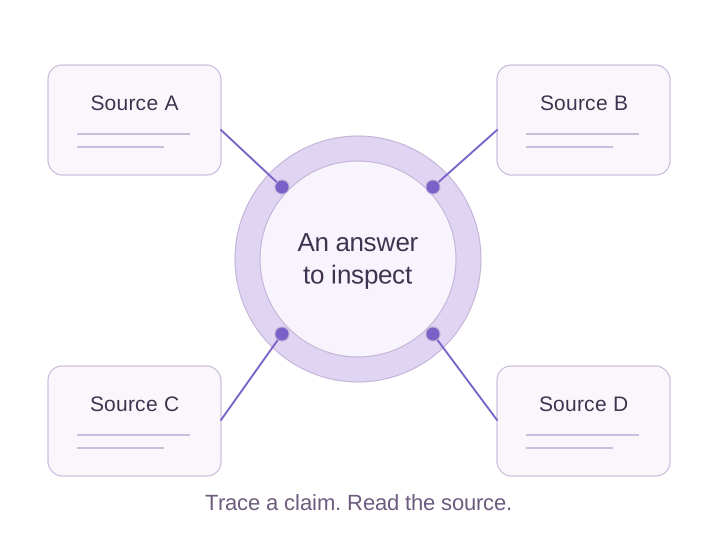
Inspect which source supports which statement.
A bounded observation
Record conditions and limits without promising citations.
The curriculum
Your next six
useful steps.
Follow the sequence or return to a lesson whenever you need it. Read, try the task and check your reasoning.
Ground the brief
Define the terms and make information clear and verifiable.
Examine the answer
Inspect citations and distinguish the different AI experiences.
Observe with care
Design a bounded test and separate observation from inference.
Your final project · The evidence observatory
An evidence-first AI-search brief
Use a fictional business and five customer questions. Design better explanations and a bounded way to observe AI answers.

A real chance to practice.
A list of five questions and the actual information needed.
A source-and-claim map for one answer.
A repeated observation protocol with conditions and limitations.
Are platform-specific facts linked to official documentation?
Does the plan avoid promising citations?
Are observation, inference and business outcome kept separate?
One illustrative approach. Your choices can differ when you explain them.
Question: what service does Harbor Workshop actually provide?
Brief separates verified repair scope from unsupported emergency guarantees.
Observation record stores question wording, date, experience and the sources actually shown.
Your project is yours to keep. Use the example to review your choices, then make it your own.
Find a project worksheet